White Label vs Your Own Branding: Which Do You Need?
A client asks, mid call, why the report you just sent has another company’s name at the bottom of every page. It lands badly, because the honest answer is that you use a tool to build the report and the tool signs its own work. That question is the kind of thing that sends an agency looking at white label. But the decision splits into two things that get talked about as though they were one: removing somebody else’s brand, and putting yours in its place.
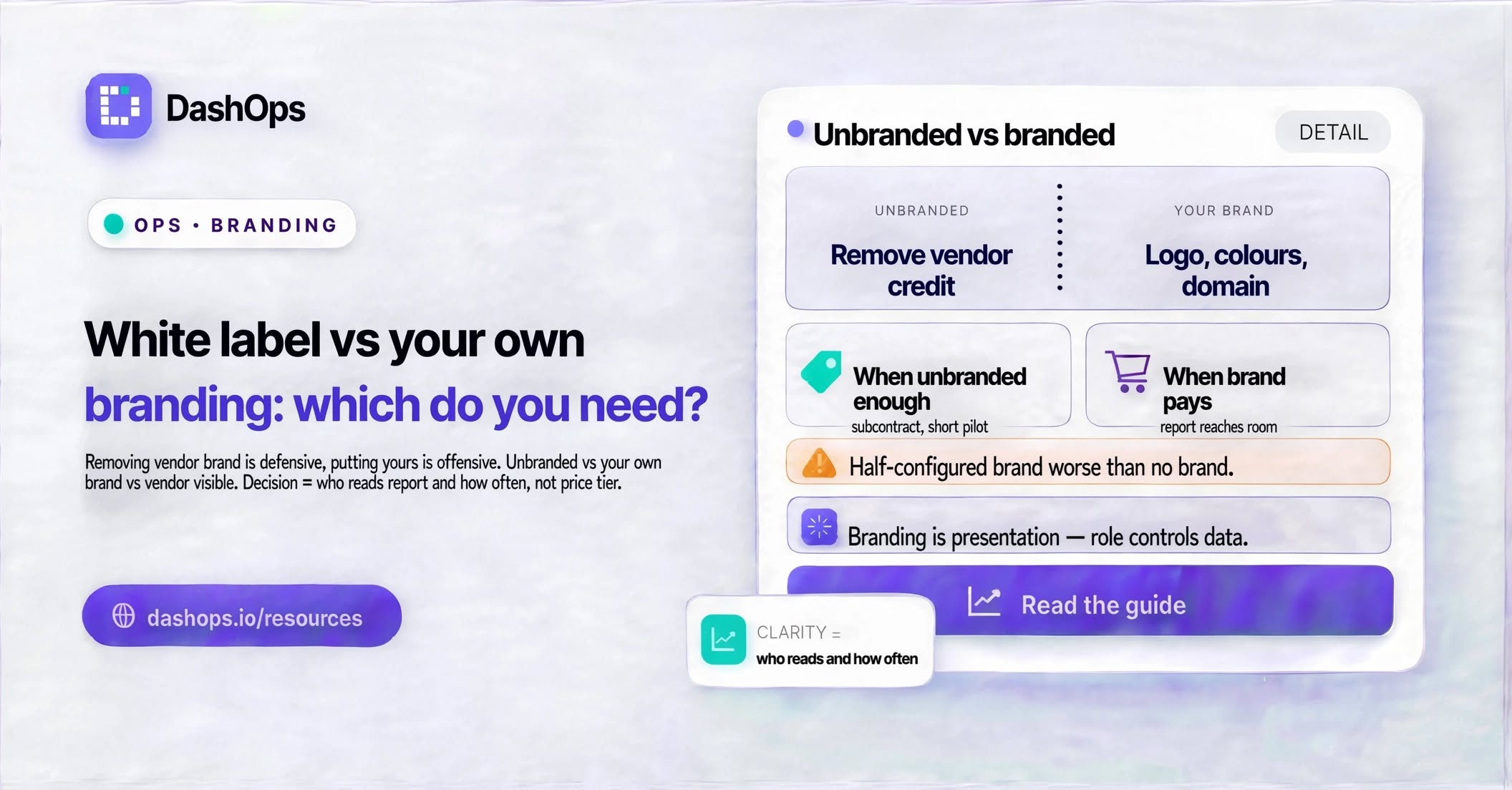
They are not the same choice. Removing a vendor’s name is defensive, and it stops an awkward question. Putting your own logo, colours and domain on the reporting is offensive, and it changes what the client thinks they are paying for. You can do the first without the second, and plenty of agencies should.
The two things people mean by “white label”
The phrase covers two separate decisions that get discussed as though they were interchangeable.
Unbranded. The vendor’s name, logo and footer credit are gone. The report or dashboard looks neutral. Nothing points back to the tool. The client sees numbers and nothing else.
Your own brand. Your logo sits in the header, your colours run through the interface and the charts, your favicon appears in the browser tab, and on the top tier the dashboard lives at a URL you control, with email from an address at your domain. The client sees your agency every time they check performance.
There is a third state, leaving the vendor’s brand visible, which is usually a default rather than a decision. It can be a deliberate one, and there is a section on that below.
When plain unbranded is enough
Unbranded is a legitimate end state, not a rung on a ladder. Reach for it when:
- You are the operator, not the agency of record. If you subcontract to other agencies, your own brand on the report is a liability. Their client is not supposed to know you exist.
- Your client relationship is one person, over email. A founder who reads a PDF once a month and replies with two questions is not forming a brand impression from the report header. Removing the vendor credit is the whole job.
- You are early and your brand is not settled. If your logo is new and your colours might still change, putting them across a client-facing dashboard now means redoing it later. Neutral commits you to nothing.
- The engagement is short. A one-off audit or a brief pilot does not need a branded portal. It needs clean numbers and a clear recommendation.
Unbranded is also the honest choice when your reporting is not yet good. Branding a thin report attaches your name to thin work. Fix the report first.
When your own branding earns its keep
Your brand starts paying when the client interacts with the reporting repeatedly, and when other people inside the client’s business see it.
The moment that changes the calculation is the same one every time: the report stops going to one person and starts going to a room. Your contact forwards it to a founder, a finance lead, or a board. Those people never spoke to you, and the document is the only version of you they meet. A neutral PDF says a report happened. A branded dashboard says an agency is running this, and here is who they are.
Branding also earns its keep when you want the client checking numbers between reports. A login they visit on a Tuesday afternoon, in your colours, is a different relationship from a PDF that arrives on the first of the month. It makes your work continuously visible rather than periodically visible, and continuously visible work is harder to cut. The argument for and against that effect is in does white label reporting win clients.
The strongest case is the retainer you want to defend at renewal. A client who has spent the whole engagement logging into something that looks like your agency has a different mental model of what they are buying than one who receives an anonymous spreadsheet.
The case for leaving the vendor’s brand visible
Nobody makes this argument, so here it is. Leaving the tool’s name on the report is not always weakness.
If you are selling transparency, a visible tool name is evidence. A client who has been burned by an agency inventing numbers may read a recognisable platform as a signal that the data is not being massaged in a spreadsheet on your laptop.
The other honest reason is capacity. Branding is not free. Somebody has to prepare a logo that reads well at small sizes and on dark backgrounds, choose colours that survive being turned into chart series, and check the result is legible on a phone. A half-configured brand looks worse than no brand.
What each level actually costs you
The pricing conversation gets the attention, but the real cost is setup and maintenance, and it differs sharply between the levels.
Unbranded costs one toggle. In DashOps that is a switch that hides the footer credit. There is nothing to maintain and nothing to break.
Your own brand, in-app costs a logo file, a favicon, and two colours. Set once, applied everywhere: the sidebar, the dashboard, the PDF and Excel reports, and the share links you send. The ongoing cost is negligible, though the up-front cost is real if your brand assets are messy.
Your own domain and email sender carries genuine ongoing overhead: DNS records at your registrar, a verified sending domain so report emails arrive from your address rather than a platform one, and someone who notices if a record is removed during an unrelated DNS change. It reads most like your agency built the software, and it is the level most likely to break quietly. The setup and the failure modes are in setting up a custom domain for a client dashboard.
A useful rule: take the branding level you can maintain without thinking about it, not the highest one your plan permits.
The decision, in one pass
Work down this list and stop at the first yes.
- Do you subcontract to other agencies? Unbranded. Your brand would break the relationship.
- Does the report reach people who have never spoken to you? Your own brand. They meet the document, not you.
- Do you want the client checking numbers between reports? Your own brand, with a login rather than a file.
- Is the engagement short, or the client a single hands-on founder? Unbranded is enough. Spend the effort on the analysis.
- Will nobody at your agency own the setup? Unbranded, until somebody will.
None of these questions is about price tiers or feature lists. They are about who reads the report and how often, and that changes as an account grows, which means the right answer at the start of an engagement may be the wrong one once it matures.
Where the branding actually lands
Check how many surfaces the branding reaches. Branding that stops at the dashboard and leaves the exported PDF neutral is a half measure, because the PDF is the artefact that travels furthest.
In DashOps, the branding you set applies to the dashboard interface, the PDF and Excel reports, the scheduled report emails, and the read-only share links you send to people without logins. On the top tier it extends to your own domain and email sender. The point is that a client should never see two different identities depending on which door they came through.
If your reporting is not on a schedule at all, branding is the wrong first problem. Get the reports arriving reliably first, using something like a weekly digest per ad account, then decide whose name goes on them.
What to do next
Pick one client and answer the decision list above for that account specifically, rather than for your agency as a whole. You may land on different answers for different accounts, which is fine, because the branding is configured once and the choice of who receives what is separate.
If the answer is unbranded, switch off the footer credit and stop there. If the answer is your own brand, get the logo and two colours in place this week, and leave the custom domain until the in-app version has run for a while without complaints. For the wider context, the full guide to white label Facebook Ads reporting covers the surrounding decisions this post left out.
Frequently asked questions
Is unbranded the same thing as white label?
Will a client be annoyed if they find out I use a reporting tool?
Should I brand every client the same way?
Do I need a custom domain, or is a logo enough?
Does branding change what data the client sees?
See it in your own dashboard
DashOps brings Meta Ads reporting, campaign management, and white-label client portals into one place. Pick the plan that fits how you run ads.