Does White Label Reporting Actually Win Clients?
You are on a pitch call. The prospect has already met other agencies this week and they all said roughly the same thing about creative testing and audience strategy. Then you get to the part where you explain how they will see results. You share your screen, and the question you are quietly asking yourself is whether the branded dashboard you set up is going to make any difference to whether this person signs.
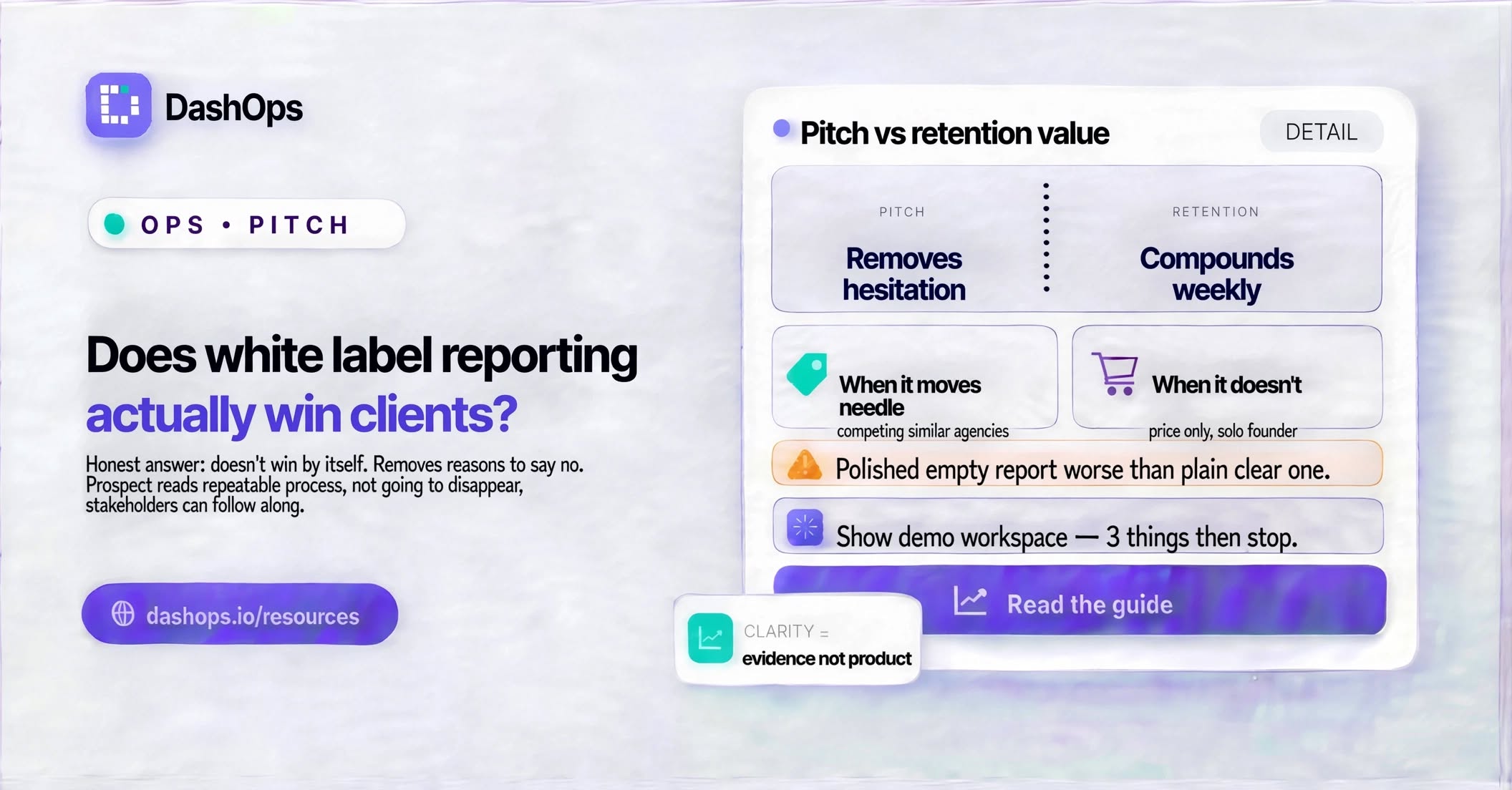
Here is the honest answer, and it is not the one most tool marketing gives you. White label reporting does not win clients by itself. What it does is remove reasons to say no, and in a competitive pitch that is often the thing that decides it.
What a prospect is actually judging when you show them reporting
Nobody in a sales conversation is evaluating your dashboard as a piece of software. They are using it as a proxy for something they cannot measure directly, which is what it will be like to work with you month after month.
When you show a branded workspace with their name on it, the prospect reads a few things at once:
- You have done this before. The setup exists, it works, and you did not improvise it for this call.
- Your process is repeatable. If the reporting is systematised, the assumption is that the campaign management is too.
- You are not going to disappear. A vendor who has invested in how they communicate is a vendor who expects a long relationship.
- Their own stakeholders will be able to follow along. This one matters more than agencies think.
That last point is where most of the real value sits. The person you are pitching is rarely the only decision maker. They will have to explain your invoice to a finance lead, or forward a performance summary to a founder who never reads anything longer than a page. Reporting that carries their branding rather than an unfamiliar tool’s branding travels through an organisation much more easily.
Where the effect is real, and where it is not
Being specific about this matters, because a lot of agencies over invest in branding and under invest in the substance of what the reporting says.
White label reporting tends to move the needle when:
- You are competing against other agencies of similar size and similar claimed expertise, so differentiation has to come from operational signals.
- The prospect has had a bad experience before and is scanning for evidence of professionalism.
- The buyer will have to justify the spend internally to people who never attend your calls.
- You are pitching a retainer rather than a project, so the client is buying an ongoing relationship, not a deliverable.
It tends not to matter much when:
- The prospect is a solo founder spending their own money and making the decision alone in the room.
- Price is the only variable in play and you are the more expensive option.
- The prospect is technical enough to want raw platform access and will ask for it regardless.
- Your reporting is branded but says nothing useful, in which case the branding just makes the emptiness look deliberate.
That final case is worth sitting with. A polished report containing metrics with no interpretation is worse than a plain one with a clear paragraph of analysis. Branding raises expectations. If what is inside does not meet them, you have created a gap the client will notice.
What actually closes the loop in a pitch
If you want reporting to contribute to winning the deal rather than just decorating it, the move is to show rather than describe.
Have a demo workspace ready with obviously fictional data, something like Contoso or Tailspin Toys, and walk through it briefly during the call. Point at three things: the headline numbers the client will care about, the drill down from campaign to ad set to ad so they know nothing is hidden, and the email that will land in their inbox every week without them asking. Then stop talking about it.
A short look is enough. If reporting becomes the centrepiece of your pitch, you have accidentally told the prospect that reporting is the most interesting thing about your agency. The reporting is meant to be evidence of competence, not the product.
The other move that consistently helps is offering the client their own login rather than a PDF attachment. A read only view scoped to their ad accounts, with spend hidden if that suits the commercial arrangement, changes the conversation from “we will send you numbers” to “the numbers are already there whenever you want them.” In DashOps that is a Client role with per account assignment, so the client sees their own data and nothing else. The psychological difference between being sent information and having access to information is larger than it sounds.
The retention argument is stronger than the acquisition one
Most agencies pitch white labelling as a new business tool. In practice the compounding return is on the clients you already have.
A prospect encounters your reporting once or twice during a sales process. An existing client encounters it every single week, for as long as the relationship lasts. Over that period, branded reporting stops being a document and becomes part of how the client thinks about their own marketing operation. The dashboard with their logo on it starts to feel like theirs, not yours and not a vendor’s.
That is genuinely difficult for a competing agency to dislodge. Switching agencies then means switching a workflow the client’s whole team has absorbed, not just switching who buys the media. Nothing about that is measurable, and it is not something you can put in a proposal, but agencies who have run branded client workspaces for a long time tend to describe the same pattern.
Decide what your branding is doing before you set it up
There is a real choice underneath all of this, and it is a positioning question rather than a technical one. Some agencies want their own name on everything because their brand is part of what they are selling. Others want the client’s brand to dominate because they position themselves as an extension of the client’s team. Both work. What does not work is doing it by accident and ending up with a report carrying three logos and no clear owner.
Whichever way you go, set it once and let it carry. In DashOps the logo, colours and favicon are configured in one place and flow through the dashboard, the PDF and Excel reports, and the scheduled client emails, so there is nothing to keep in step by hand.
If you are weighing that up, white label versus your own branding covers the trade off in more detail, and running the dashboard on your own domain is the version that removes the last visible trace of an outside tool. For the full picture of how branded Meta Ads reporting fits together, the complete guide to white label Facebook Ads reporting is the place to start.
What to do next
If you are trying to work out whether this is worth your time, run a small test rather than a big rebuild.
Pick your next three pitches. Set up one branded demo workspace with fictional data, show it briefly in each call, and pay attention to what happens in the conversation immediately afterwards. You are listening for a shift in the questions. If prospects move from asking whether you can handle their account to asking about onboarding timelines and contract terms, the reporting is doing its job. If the conversation does not change at all, your bottleneck is somewhere else, most likely positioning or price, and no amount of branding will fix it.
Then apply the same branding to your existing clients before you apply it to anyone new. That is where it will earn the most, and it is the cheapest thing on your list to do.
Frequently asked questions
Does white label reporting win clients on its own?
When is white label reporting most likely to matter in a pitch?
Should I mention white labelling in my proposal or wait until onboarding?
Does it help with retention as much as with new business?
What is the difference between white labelling and just adding my logo?
See it in your own dashboard
DashOps brings Meta Ads reporting, campaign management, and white-label client portals into one place. Pick the plan that fits how you run ads.