What Is a Good CTR for Facebook Ads? Benchmarks and Formula
The short answer on a good CTR
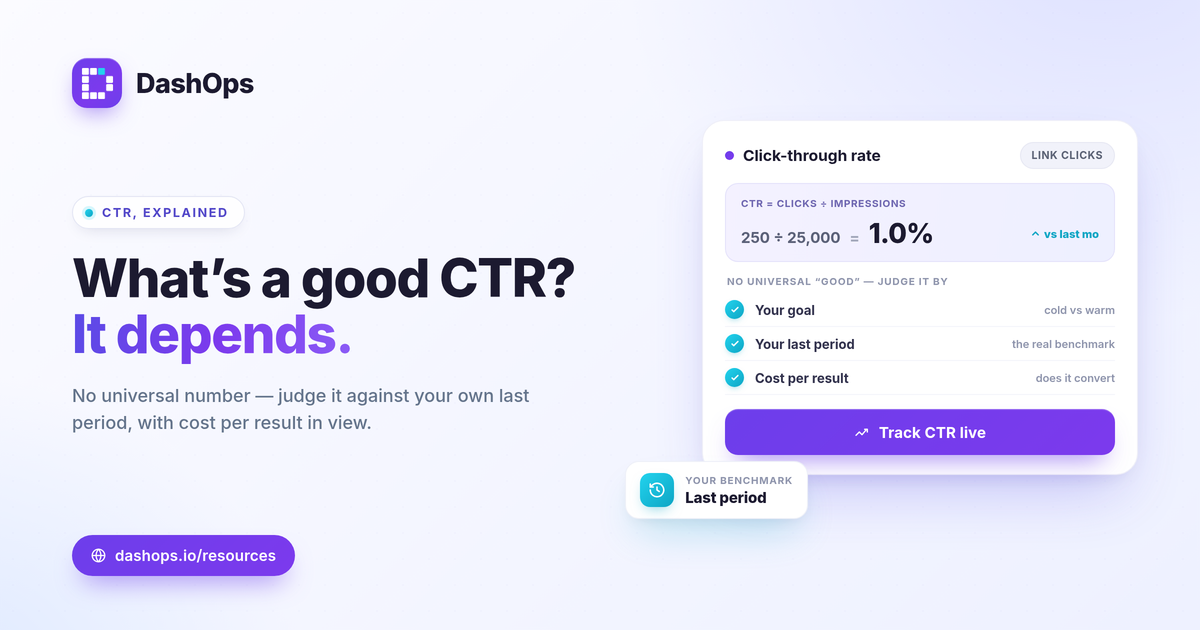
What is a good CTR for Facebook ads is best answered by your own goal and trend, not a single universal number. There is no honest figure that is good for every account, because CTR shifts with placement, audience, industry, and objective. The useful test is direction: a CTR that holds steady or climbs against your own prior period, on the same campaign and audience, while cost per result stays flat, is good for you. A CTR sliding over several weeks is the warning sign, whatever any external chart claims. CTR measures how compelling your ad is at earning the click. It does not tell you whether that click converts, which is why you read it next to cost per result and ROAS.
The click-through rate formula
The click-through rate formula is simple and worth stating exactly:
CTR = clicks / impressions, expressed as a percentage.
If an ad earned 250 clicks across 25,000 impressions, the calculation is 250 / 25,000, which equals 0.01. Multiply by 100 to get the 1 percent figure Meta displays. The arithmetic is the easy part. The judgment is deciding whether that result is good for your goal, which no formula can do for you.
One detail trips people up. Meta reports more than one CTR:
- CTR (all) counts every click on the ad, including likes, comments, profile taps, and expands.
- CTR (link click-through rate) counts only clicks that head to your destination, like a website or lead form.
These two numbers can differ a lot on the same ad. Link-click CTR is the one most advertisers care about, because it reflects intent to leave Facebook or Instagram and reach your offer. When you compare CTR across reports or against any industry range, confirm you are comparing the same definition. Mixing all-clicks CTR from one source with link CTR from another makes the comparison meaningless.
Good, average, and poor: how to actually judge
There is no honest single average CTR for Meta ads that applies to every account, because the number depends on too many variables. Instead of chasing a universal figure, judge CTR three ways.
- Against your goal. A cold prospecting campaign and a warm retargeting campaign will not produce the same CTR, and they should not. Set the expectation per campaign type.
- Against your own history. Your last period is the most useful benchmark you have. A CTR that beats last month on the same audience and creative is good for you, regardless of what any external chart says.
- Against your downstream numbers. A strong CTR that produces expensive or low-quality results is not actually good. Pair it with cost per result and ROAS before you celebrate.
If you want category context, an industry benchmark range can help you sanity-check whether you are in a sensible neighborhood, as long as you treat it as orientation and not a target. Our Facebook ads CTR benchmark by industry post walks through how to use those ranges without letting them set your expectations for you.
Why CTR moves, and what it tells you
CTR rarely sits still. Reading the direction of travel is more useful than reading any single snapshot.
- A falling CTR over several weeks often signals creative fatigue. The same people have seen the ad too many times and stopped engaging. You can confirm this by checking frequency, which is a KPI on its own. A climbing frequency next to a sliding CTR is the classic fatigue pattern.
- A sudden CTR drop after an edit usually points to a creative or audience change you made. Compare the period before and after the change to isolate it.
- A CTR spike with weak results can mean the hook is attracting clicks that do not match the offer. High interest, low intent.
- Placement differences. Feed, Stories, Reels, and the Audience Network do not perform the same. A blended account CTR can hide a weak placement dragging the average down, which a placement breakdown will surface.
This is why CTR belongs in a set of metrics, not on its own. It is one signal in the chain from impression to result. For the wider picture of which numbers to watch together, see Meta ads KPIs to track.
How to improve CTR on Facebook ads
When CTR is below where you want it, the levers are mostly creative and targeting, not budget.
- Lead with a stronger hook. The first frame or first line does most of the work. If the opening moment is weak, the rest of the ad rarely gets seen.
- Match the message to the audience. A cold audience needs a different angle than a warm one. Generic creative to a specific audience usually underperforms.
- Refresh tired creative. If frequency is high and CTR is falling, new creative is the fix, not a bigger budget on the same ad.
- Tighten or broaden targeting deliberately. Both can help depending on the symptom. Test one change at a time so you can read the effect.
- Check the placement mix. If one placement is dragging the average, isolating or excluding it can lift overall CTR.
After any change, give it a fair window and then compare periods. CTR is noisy day to day, so a clean period-over-period comparison beats reacting to a single bad afternoon.
Where CTR lives on the DashOps dashboard
CTR is one of the 17-plus Meta KPIs DashOps reads straight from your connected ad accounts, shown next to spend, impressions, clicks, CPC, CPM, frequency, and your result metrics. Each KPI comes with built-in period-over-period comparison and a trend chart, so you see whether CTR is holding, climbing, or sliding rather than guessing from a single figure. Demographic and placement breakdowns let you check whether a weak placement or audience is pulling the average down, and frequency sitting beside CTR makes fatigue easy to spot. You can see what each plan includes on the pricing page, and the help center covers connecting your first ad account. For more on how the in-app view differs from Ads Manager, see Facebook Ads Manager vs reporting dashboard.
The practical takeaway: stop hunting for a universal good CTR and start comparing this period to your last one for the same campaign, with cost per result and frequency in view.
Frequently asked questions
What is the formula for CTR on Facebook ads?
Is a 1 percent CTR good for Facebook ads?
Does a high CTR always mean better results?
See it in your own dashboard
DashOps brings Meta Ads reporting, campaign management, and white-label client portals into one place. Pick the plan that fits how you run ads.