Reach vs Impressions vs Frequency: How the Three Meta Metrics Differ
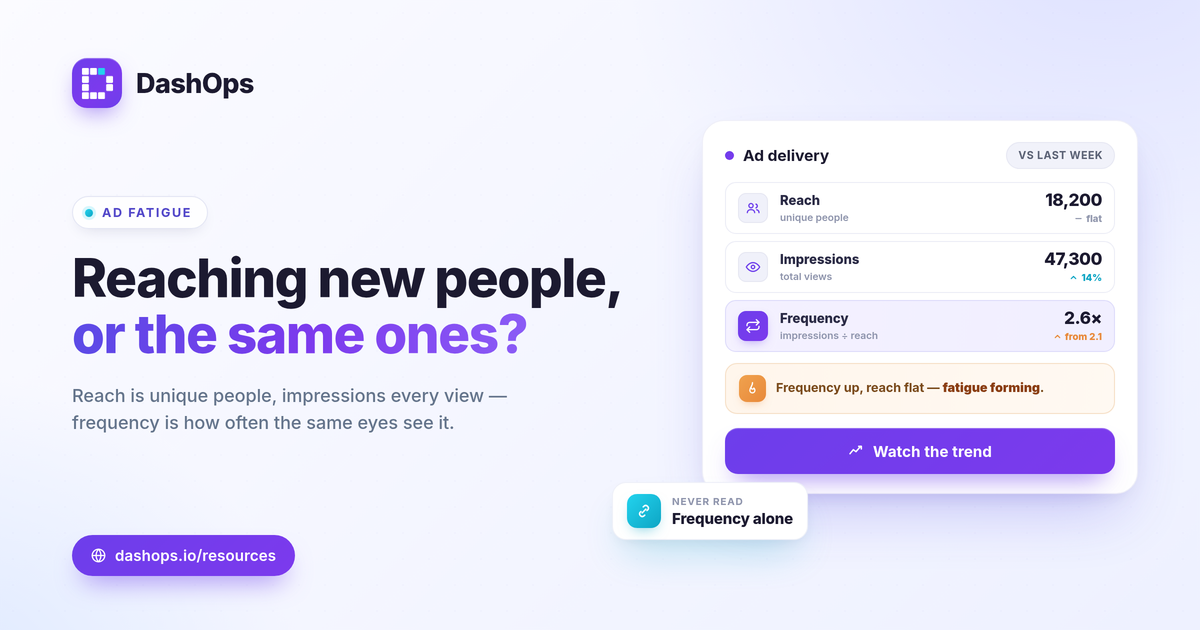
Reach, impressions, and frequency describe how your Meta ads were delivered, and they are easy to confuse because they measure related but distinct things. Reach is the number of unique people who saw your ad. Impressions is the total number of times your ad was shown, including repeat views. Frequency ties the two together: it is the average number of times each person saw the ad, calculated as impressions divided by reach. Getting reach vs impressions vs frequency straight matters because the three together tell you whether you are reaching new people or showing the same ad to the same audience over and over, which is the early signal of ad fatigue.
The three metrics at a glance
Here is the difference between reach and impressions, plus where frequency fits, in one view.
| Metric | What it counts | Repeat views? |
|---|---|---|
| Reach | Unique people who saw the ad at least once | No, counted once per person |
| Impressions | Total times the ad was displayed | Yes, every view counts |
| Frequency | Average views per person (impressions / reach) | It is the ratio of the two |
Reach is always less than or equal to impressions, because a person can be reached once but generate many impressions. Frequency is the bridge: it tells you how the impressions were distributed across the people you reached.
What reach actually measures
Reach is a count of distinct people. If Acme Apparel runs an ad and 5,000 different people see it during the week, reach is 5,000, no matter how many times each person saw it. Reach answers a single question: how many individuals did this ad touch.
This makes reach the right metric for awareness goals and for understanding the size of the audience you are actually paying to influence. It is not a measure of effort or volume. Two campaigns with the same reach can have very different delivery underneath, which is exactly why you never read reach alone.
What impressions actually measure
Impressions count every time your ad rendered on a screen, repeat views included. The same person scrolling past your ad three times generates three impressions but adds only one to reach. Impressions are the raw delivery volume and the denominator behind several efficiency metrics:
- CPM uses impressions: CPM = spend / impressions times 1000. It is the cost to show your ad a thousand times.
- CTR uses impressions: CTR = clicks / impressions. It is the share of views that produced a click.
Because impressions include repeats, a high impression count next to a modest reach count is a clue that Meta is serving your ad to the same people repeatedly. That is where frequency earns its place.
What is frequency in Facebook ads
Frequency is the average number of times each reached person saw your ad over a date range:
frequency = impressions / reach
A frequency of 1.0 means, on average, each person saw the ad once. A frequency of 4.0 means the average person saw it four times. It is an average across the whole audience, so some people saw the ad more and some less, but it gives you a single number for how hard your creative is working against the same eyes.
Frequency is one of the Meta ads delivery metrics that only makes sense in context. A broad prospecting campaign with a large audience can run for a while at a low frequency. A tight retargeting audience will naturally show a higher frequency because the pool of people is small. So there is no universal threshold that means trouble. The signal to watch is the trend.
How the three combine to reveal ad fatigue
Ad fatigue happens when an audience has seen your creative enough times that it stops responding. No single metric proves it, but the three delivery metrics read together make a recognizable pattern over time:
- Frequency climbing. The same people are seeing the ad more and more.
- Reach flattening. You have stopped finding new people, so impressions are piling onto the existing audience.
- CTR slipping and CPM rising. Engagement falls while Meta charges more to keep showing a tiring ad.
That combination, read against your own prior periods rather than a fixed benchmark, is the practical definition of fatigue. The fix is usually a creative refresh, an audience expansion, or capping how often the ad is shown. The point is that you cannot see the pattern from frequency alone. You need reach and impressions next to it, and you need the comparison to last period.
How to read them without the confusion
A few habits keep impressions vs reach explained correctly in practice:
- Never read frequency without reach. A frequency of 5 on a huge audience is a different situation than a frequency of 5 on a small retargeting list.
- Watch direction, not absolute values. What matters is whether frequency is rising and reach is stalling compared to the previous period.
- Pair delivery metrics with efficiency metrics. Frequency tells you the audience is seeing the ad more. CTR and CPM tell you whether that is still working.
- Judge “good” against your own goal and trend. Use your margin, your objective, and last period as the reference, not a number you read somewhere.
For a wider view of which numbers belong on your dashboard, see Meta ads KPIs to track, and for a deeper walkthrough of the fatigue signal specifically, what is frequency in Facebook ads covers it in more detail.
Seeing all three in one place
The reason these metrics get confused is that Ads Manager scatters them and rarely shows the period-over-period change next to each one. DashOps surfaces reach, impressions, and frequency together as part of its 17-plus Meta KPIs, each with a comparison to the prior period and a trend chart, so a frequency that is creeping up while reach flattens is visible at a glance rather than something you have to reconstruct. You can read it across multiple ad accounts in one dashboard and include it in client reports. See what each plan includes on the pricing page, and the help center covers connecting an account. If you are weighing the native tool against a dedicated view, Facebook Ads Manager vs a reporting dashboard lays out the difference.
Read reach, impressions, and frequency as a set, against your own prior period, and ad fatigue stops being a surprise.
Frequently asked questions
What is the difference between reach and impressions?
What is frequency in Facebook ads?
Is a high frequency bad for Meta ads?
See it in your own dashboard
DashOps brings Meta Ads reporting, campaign management, and white-label client portals into one place. Pick the plan that fits how you run ads.