CPM vs CPC in Meta Ads: What Each Metric Means and When to Use It
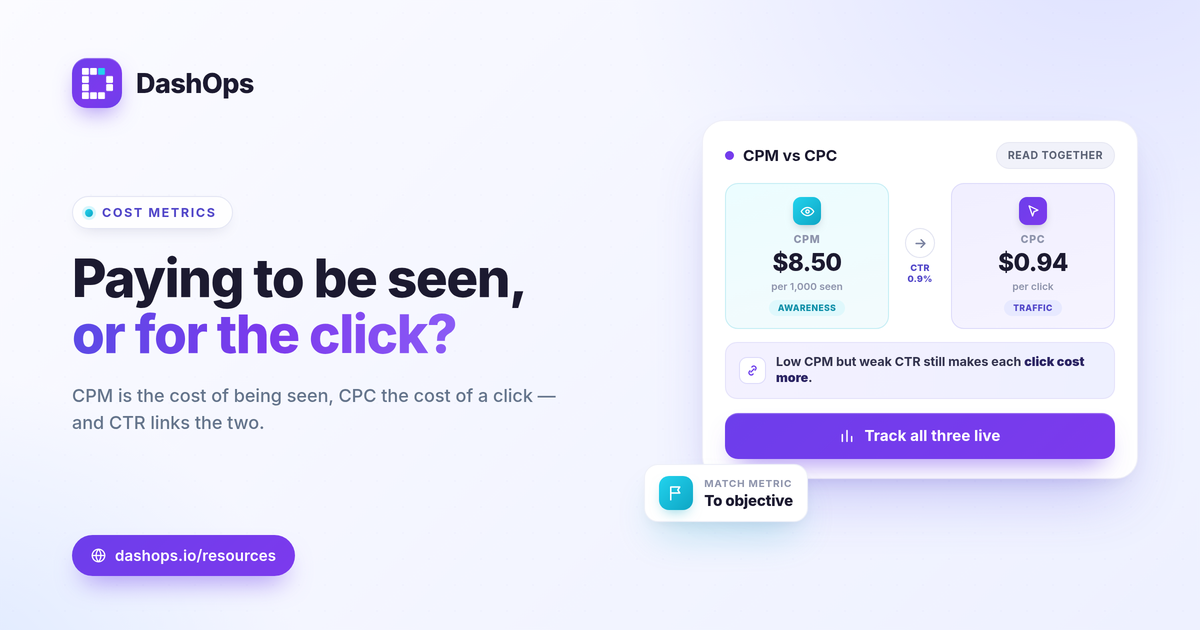
CPM vs CPC in Meta ads comes down to one question: are you paying to be seen or paying for an action. CPM, or cost per mille, is the price of 1,000 impressions and measures the cost of exposure. CPC, or cost per click, is the price of a single click and measures the cost of engagement. Neither is the better metric in the abstract. The right one to watch depends on your campaign objective, and the two are linked through your click-through rate. This guide breaks down both cost metrics, the formulas behind them, and the buying scenarios each one fits.
What CPM and CPC actually measure
Both are cost efficiency metrics, but they answer different questions.
- CPM (cost per mille). What it costs to put your ad in front of 1,000 people. The formula is CPM = spend / impressions times 1,000. It reflects auction pressure: how many advertisers want the same audience and how appealing the platform finds your ad.
- CPC (cost per click). What it costs to earn one click. The formula is CPC = spend / clicks. It reflects both the price of exposure and how compelling your ad is once it appears.
The difference between CPM and CPC is the difference between renting attention and buying a response. CPM stops at the impression. CPC only counts when someone acts.
How CPM and CPC connect through CTR
These two metrics are not independent. They are tied together by click-through rate, where CTR = clicks / impressions. A useful way to see the relationship: CPC is roughly CPM divided by 1,000 times your CTR, or put simply, cheaper impressions and a higher click rate both pull your cost per click down.
That link explains the most common confusion advertisers run into. You can have a low CPM and still see a high CPC if almost nobody clicks. The impressions are cheap, but the weak CTR makes each click expensive. The reverse happens too: a higher CPM can still produce a low CPC when the creative is strong and the click rate is high. This is why reading either cost metric in isolation can mislead you. Always look at CPM, CTR, and CPC together.
When to optimize for CPM
CPM is the metric to lead with when the goal is exposure rather than immediate action.
- Awareness and reach campaigns. When you want a defined audience to see a message, the cost to reach them is the number that matters. Clicks are secondary.
- Brand and launch pushes. New product or seasonal announcements where the job is to be seen by the right people.
- Diagnosing auction cost. A rising CPM tells you the auction got more expensive or your ad relevance slipped, independent of whether people clicked.
CPM is also the cleaner signal for spotting audience fatigue. As the same people see an ad repeatedly, frequency climbs and CPM often rises while response softens. Watching CPM next to frequency and a period-over-period trend is a practical way to catch a creative wearing out. For more on that pattern, see reach vs impressions vs frequency.
When to optimize for CPC
CPC is the metric to lead with when a click is the action you care about.
- Traffic and consideration campaigns. Sending people to a landing page, a blog post, or a product page where the click is the first real step.
- Comparing creative or audiences. CPC, read alongside CTR, shows which ad earns engagement at the lowest cost.
- Tighter budgets focused on action. When every dollar should move someone closer to a page visit rather than just an impression.
One caution: Meta reports more than one click type. Link clicks count people who clicked through to your destination, while a broader all-clicks figure includes likes, comments, and expands. For traffic decisions, link clicks and the cost per link click are usually the more honest measures of intent.
Where each metric sits in Facebook ads pricing models
Both CPM and CPC describe outcomes you can read after the fact, but they also relate to how Meta charges and how you set up buying. In practice, most campaigns are billed on impressions while Meta’s system optimizes delivery toward whatever objective you chose. So you may select a clicks or conversions objective, yet still see CPM as the underlying cost of delivery. That is why CPM stays a useful diagnostic even on action-focused campaigns: it is the base cost layer underneath your cost per click and your cost per result.
The takeaway for Facebook ads pricing models is to let the objective pick the headline metric. Awareness goals lead with cost per mille vs cost per click in favor of CPM. Traffic goals lead with CPC. Conversion goals push past both to cost per result, cost per lead, or ROAS, where CPM and CPC become supporting context rather than the verdict.
A quick side-by-side
| CPM | CPC | |
|---|---|---|
| Measures | Cost of 1,000 impressions | Cost of one click |
| Formula | spend / impressions times 1,000 | spend / clicks |
| Best for | Awareness, reach, brand | Traffic, consideration, engagement |
| Reads as | Price of being seen | Price of an action |
| Fatigue signal | Strong, with frequency | Weaker on its own |
Judging whether your CPM or CPC is “good”
There is no universal number that makes a CPM or CPC good. Cost varies by audience, placement, season, country, and how competitive your niche is in the auction. A more reliable read comes from three comparisons:
- Against your goal. Does this cost per click or per thousand still leave room to hit your cost per lead or ROAS target after the click converts.
- Against your own trend. Is this period’s CPM or CPC higher or lower than last period, using a like-for-like date range.
- Against your other ads. Which campaign, audience, or placement delivers the action you want most efficiently.
For how these cost metrics fit into a full reporting picture, see Meta ads KPIs to track.
DashOps reports CPM and CPC as native Meta KPIs in one dashboard, side by side with CTR, frequency, cost per result, and ROAS, each with period-over-period comparison so you can see whether a cost moved and in which direction. You can break the same numbers down by age, gender, and placement, and pull them into PDF, Excel, or CSV reports. See what each plan includes on the pricing page, and the help center walks through connecting an ad account. For how a live dashboard compares to digging through the native tool, see Facebook Ads Manager vs a reporting dashboard.
Pick the metric that matches your objective, then judge it against your own goals and your last period rather than a number you read somewhere.
Frequently asked questions
Is CPM or CPC better for Meta ads?
What is the difference between CPM and CPC?
Why is my CPC high when my CPM is low?
See it in your own dashboard
DashOps brings Meta Ads reporting, campaign management, and white-label client portals into one place. Pick the plan that fits how you run ads.