Scoping a Facebook Ads Contract: What to Put in Writing
A prospect says yes to your Facebook Ads proposal, and not long after you are building landing pages, writing every ad from scratch, editing video, chasing their web developer about a pixel, and sitting on a Thursday call explaining why last week looked different from the week before. None of that was in the proposal. You did not say no to any of it, because saying no felt like being difficult. Now the work has swollen past the fee and you cannot point to the sentence where it should have stopped.
The fix is not a longer contract. It is a contract that draws lines in the four places the work actually leaks: what you touch, what you produce, what the client owes you, and what happens when things change. Get those four right and most scope arguments end before they start, because the answer is already written down and the client signed it.
This post is about the scoping section specifically. If you want the wider view of setting up as a freelance paid social operator, the freelance paid social tools guide covers the rest of the stack. For what to charge once the scope is drawn, see pricing Facebook Ads management.
Name the surface you are responsible for, and only that
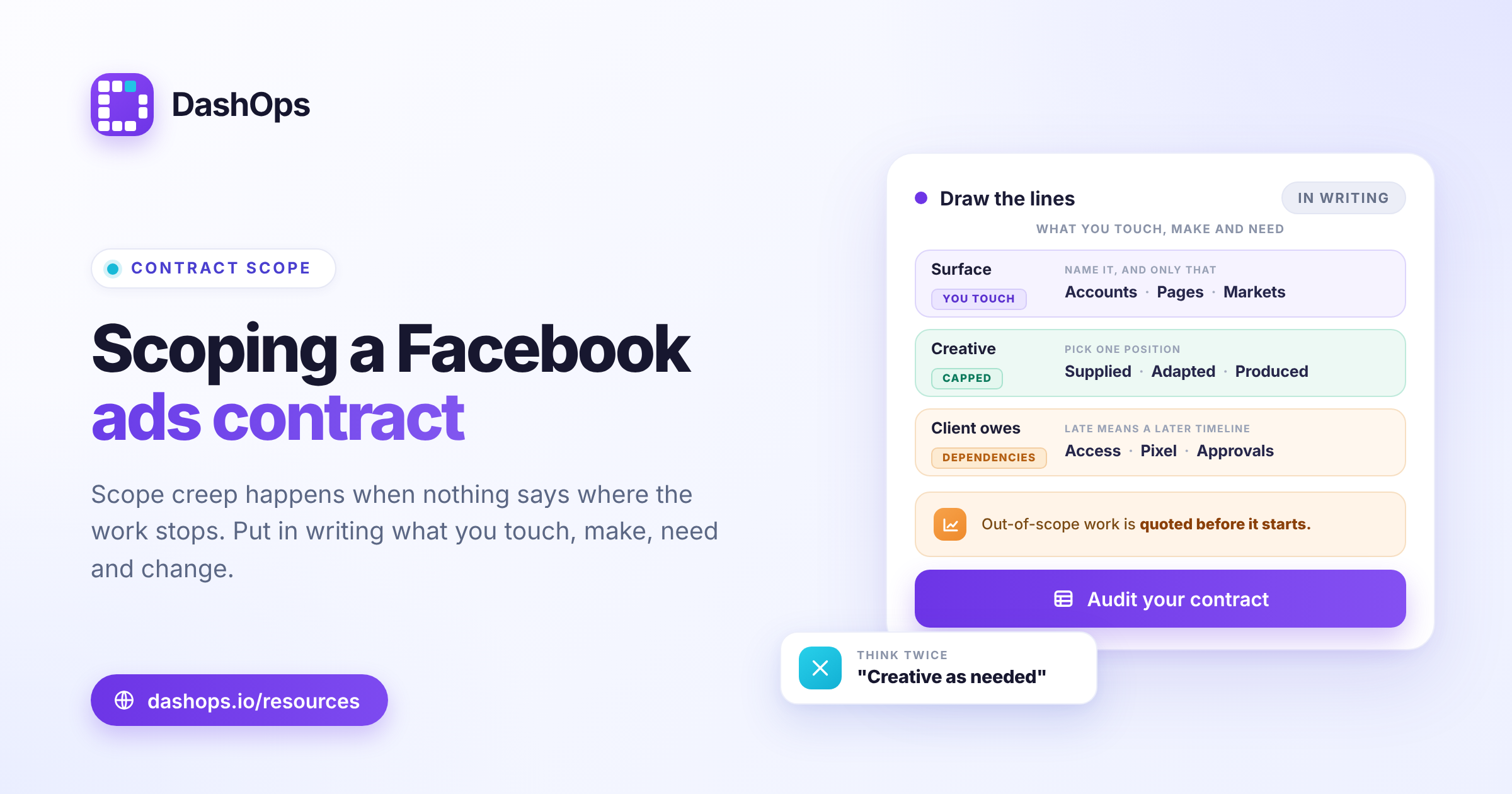
The first line of the scope should say which ad accounts, which Pages, and which markets. Not “Facebook advertising for Northwind Solar”. If Northwind opens a second ad account for a new region, that is a new line in the contract, not a favour.
Write it as a list, not a sentence:
- Ad account act_DEMO_001, Northwind Solar main account
- One Facebook Page and its connected Instagram account
- Lead generation campaigns only, in the United Kingdom
- Meta only, no other advertising platform
That last bullet does more work than it looks like it does. Clients often assume “the ads person” covers Google, TikTok and whatever their competitor just started doing. If your contract says Meta only, the request to look at Google search becomes a proposal instead of an assumption.
Being this literal helps operationally too. However you keep track of client accounts, whether that is one dashboard holding all of them, which is what DashOps does, or a folder of bookmarks, the list in the contract and the list you actually log into should match. When those two drift apart, you end up working on something nobody agreed to pay for.
Separate what you manage from what you make
The easiest place for a Facebook Ads scope to break down is creative. The client hears “you run the ads” and pictures you producing the ads. You picture yourself deploying assets they supply. Both readings are reasonable, which is exactly why it has to be written.
Pick one of three positions and state it plainly:
- Client supplies creative. They deliver images, video and product photography in agreed sizes. You write ad copy, build the ads and manage placements.
- You adapt supplied creative. They give you source assets and you resize, crop and reformat them for feed, story and reel placements. No original shooting, no design from scratch.
- You produce creative. Named quantity, named formats, named revision limit.
If you go with the third, cap it by count and by revision. A named number of ad concepts per month, with a named number of revision rounds on each, is enforceable. “Creative as needed” is a standing invitation to be a design studio for the price of an ads retainer.
Do the same for landing pages. If the destination is their site, say your responsibility ends at the click. If the page converts badly, you will flag it, and fixing it is a separate engagement.
Write down what the client owes you
A scope that only lists your obligations is half a scope. Client dependencies belong in the contract because they are the reason deadlines slip, and because a missed dependency should pause your clock rather than compress your delivery.
The ones worth naming for Meta work:
- Admin access to the Business Manager, ad account and Page, granted through Business Manager rather than shared logins
- The Meta Pixel installed on the site with the events you need, or developer time booked to install it
- Approval on ad copy and creative within a stated number of working days
- Somewhere for leads to land, and a named person who follows them up
- Anything they are legally required to sign off, which matters in finance, health and property
Add one sentence saying what happens when a dependency is late: the timeline moves, the fee does not. That sentence prevents the conversation where a client who was slow to approve copy asks why the month underperformed.
Define reporting as a deliverable, not a vibe
“Regular reporting” is the phrase that quietly costs freelancers their evenings. Define the artefact, the cadence and the channel, then build it once and let it repeat.
Say what the client receives: a monthly PDF covering spend, results, cost per result and the campaigns that drove them, plus a weekly email summary. Say how it arrives. Say what it does not include, which is usually the interesting part. Ad hoc pulls, custom breakdowns, and “can you also show me this by age” are requests, and requests either fit in your included hours or they are billed.
Then make the promise cheap to keep. DashOps generates PDF reports on demand, and Excel on Growth and Enterprise, and sends scheduled client reports by email, so the deliverable you committed to in writing lands without you rebuilding it every month. If you would rather the client had constant visibility instead of a monthly document, a read-only dashboard login scoped to their ad account does that, with spend hidden if your arrangement calls for it. Either way the contract clause and the actual workflow match, which is the point.
The mechanics of setting that up are covered in how to automate Facebook Ads reports.
Cap the meetings and the messages
Communication is scope. A client on a monthly retainer who books a long call every week and messages you daily is consuming a different amount of your life than one who reads the report and replies with questions.
Name the meeting rhythm and the length. Name the channel for everything else, and give a response window in working hours rather than minutes. If you offer a strategy session, say how often and how long.
This is not about being cold. It is about the client knowing what good looks like, so neither of you is guessing whether you are being responsive enough. It is also what decides how many clients you can carry at once, which is worth reading alongside how many clients a freelancer can handle.
Handle budget, ad spend and the moving parts
Two things trip people up here.
First, state that the media budget is separate from your fee and is paid by the client directly to Meta on their own payment method. If you ever put ad spend on your own card, say so explicitly, say what the ceiling is, and say when you are reimbursed. Fronting spend without a written limit is how a freelancer ends up financing a client.
Second, decide what happens when the budget changes materially. Managing a small test budget and managing a large always-on account are different jobs with different amounts of work in them, even though the campaign structure looks similar. Write a review trigger: if monthly spend moves beyond an agreed band, the fee is revisited before the next cycle. You do not have to name the band in this article, but you do have to name it in the contract.
Put a change process in the contract
The section that saves the most grief is the shortest. Say that work outside the scope is quoted separately, in writing, before it starts, and that agreeing it in a call or a chat message does not count until it is confirmed by email.
That single clause changes the shape of the conversation. Instead of “can you also do X” landing as an obligation you have to refuse, it lands as a request you can price. Clients rarely mind paying for extra work. They mind being surprised by an invoice, and freelancers mind doing unpaid work. A written change process solves both.
Say when it ends and what the client keeps
Close the scope with the boring administrative facts, because they are the ones people argue about later.
State the initial term and the notice period. State that the ad account, the Page, the Pixel and the data belong to the client and stay with them. State that you will hand back full admin access on the last day and remove your own. If you built audiences, forms or campaign structures in their account, they keep those too.
Being explicit here is a selling point, not a risk. A prospect comparing two proposals will notice the one that says plainly what happens if things do not work out. It reads as confidence.
What to do next
Open your current template and check it against six questions. Does it name the specific ad accounts and Pages? Does it say who makes the creative and how many pieces? Does it list what the client must provide? Does it define the report as an object with a cadence? Does it cap meetings? Does it explain how out-of-scope work gets quoted?
Every no is a place a future argument is already waiting. Fix those six before your next proposal goes out, and pair it with a solid first-week process using freelancer client onboarding for ads, so what the contract promises and what actually happens are the same thing.
Frequently asked questions
What should a Facebook Ads contract scope actually list?
How do I stop clients asking for creative that was never included?
Should ad spend be part of my fee?
How specific should the reporting clause be?
What happens if the client is slow to give access or approvals?
See it in your own dashboard
DashOps brings Meta Ads reporting, campaign management, and white-label client portals into one place. Pick the plan that fits how you run ads.